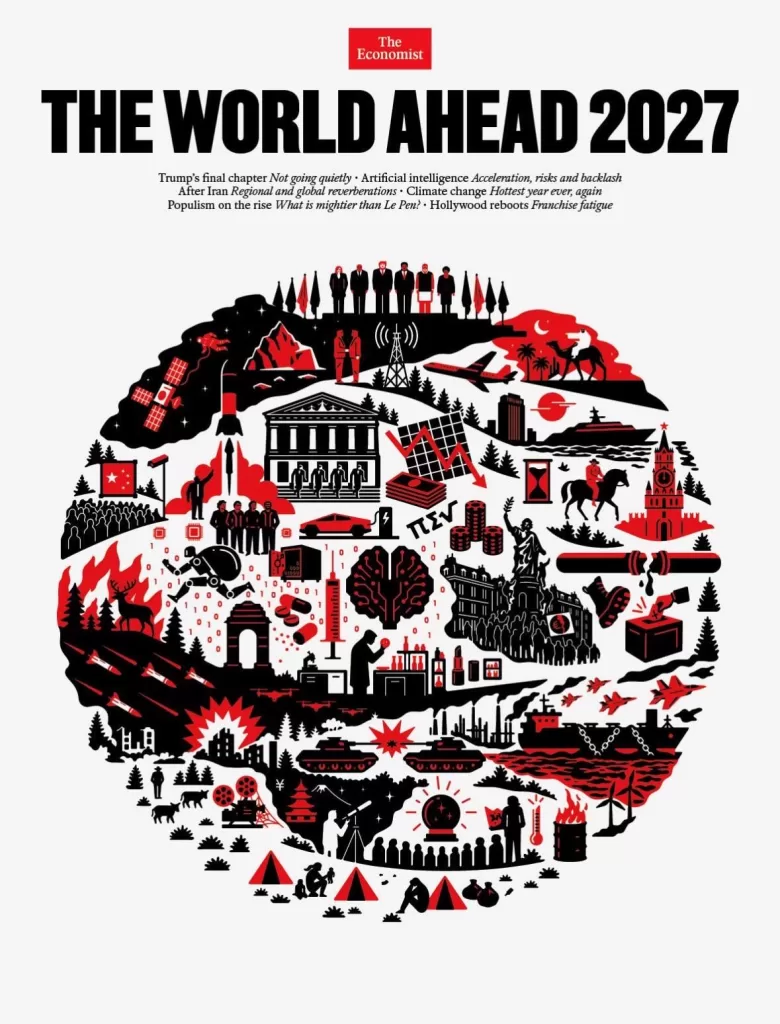
Every year-end, the cover of The World Ahead, The Economist’s annual edition, goes viral. Social media fills up with theories about hidden messages and “predictions” that are supposedly going to come true. The The World Ahead 2027 edition, officially presented on November 17, 2026, is no exception. Before interpreting anything, it’s worth clarifying what this cover is and what it is not.
What does the cover show? An image open to interpretation
The cover is authentic and is backed by the official press release from The Economist Group. That release confirms the main themes of the edition, but it does not offer a symbol-by-symbol explanation. This matters: any detailed reading of each visual element is an interpretation, not a statement from the magazine.
What we can say with certainty is that the edition revolves around artificial intelligence, geopolitical tensions, financial fragility, extreme weather events and social and cultural transformations.
What does The Economist actually say?
The publication does not write a prophecy. It presents risks, scenarios and trends that it considers relevant for the coming year. That is the difference between saying “this may happen if certain factors combine” and “this is going to happen.” Let’s go over the main themes.
1. Artificial intelligence: expansion and financial risks
The magazine highlights the rapid growth of AI and also its shadows: concerns about cybersecurity and the debt taken on by tech companies investing enormous sums. A financial correction in the sector is a possible risk, not a confirmed outcome.
2. Conflicts that shake the economy
The consequences of the Iran war, changes in energy trade and tensions around Taiwan occupy a central place. Here it is necessary to distinguish three things: military preparation, the conflict scenarios being analyzed and the decisions that are actually made. They are not equivalent.
3. Public debt and bond markets
The Economist warns of greater financial strains in developed countries. To understand this, it helps to know what a bond market is: it is where governments and companies borrow from investors. If investors lose confidence, they demand higher interest rates, and that makes financing more expensive not only for the borrower but often for the rest of the economy, including emerging countries.
4. Climate change and food security
Droughts, wildfires, extreme heat and possible disruptions in fertilizer supply are among the concerns for 2027. These are general risks based on known trends, not exact forecasts of what will happen in a specific place and time, which are always subject to uncertainty.
5. Health, medicines and new habits
The so-called “Ozempic effect” appears as a transformation of the market for weight-control medications and of certain consumption patterns. The same goes for longevity research: it is a developing field, and anti-aging benefits should not be presented as established clinical results.
6. Politics, space and entertainment
The edition also covers political disputes in the United States and Europe, the commercial expansion of space and changes in Hollywood. It is a useful signal: the cover doesn’t speak only of threats, it also reflects technological and cultural transformations.
Why should we care in Central America?
The Economist made no specific forecasts for Costa Rica or the region. Even so, it is reasonable to ask how global trends might reach us here. These are plausible connections to keep an eye on, not guaranteed consequences:
- Energy volatility: could translate into changes in fuel and transportation costs.
- Fertilizer tensions: could put pressure on agricultural production costs.
- The growth of AI: could change services, employment and productivity, in a country with a very significant services sector.
- International financial pressure: could mean tougher financing conditions.
- Extreme heat and climate variability: pose risks to agriculture, water resources and infrastructure.
- Pharmaceutical transformations: could generate new demand for health products and services.
How to read a cover without falling into sensationalism
Faced with an avalanche of viral content, a few simple rules help keep a cool head:
- Look for the primary source. The official press release says more than any interpretation video.
- Separate facts from personal readings. If the magazine didn’t explain a symbol, any meaning is an opinion.
- Distinguish risk from prediction. A warning is not destiny.
- Be wary of secret meanings. Editorial covers aim to summarize themes, not hide messages.
An invitation to look at the big picture
The biggest lesson of The World Ahead 2027 may not lie in any one symbol, but in the connection between the themes: technology influences the economy, the economy influences politics, politics influences security, and all of it intersects with climate and health. In such an interconnected world, a shock in one place can be felt very far away.
The cover does not reveal a future written in advance. It invites us to observe closely, to stay well informed and to prepare, as individuals, businesses and countries, for a year in which many things will depend on the decisions that are made.