0
No products in the cart.

Classic sneakers 2026: the pairs that tell who you are

  • Comments: 0
  • Posted by: Andrés David Vargas Quesada

2026 will not be remembered as the year of the most viral releases, but as the moment footwear regained emotional depth. Amid fleeting collaborations, accelerated drops, and sales driven by urgency, certain pairs begin to occupy a different symbolic space. Classic sneakers 2026 do not seek immediate protagonism; instead, they integrate into daily life with a quiet, persistent presence. They speak of cities walked, bodies in motion without haste, and stories accumulated step by step. Against the constant noise of impulse consumption, choosing well becomes an act of identity. In this context, footwear stops being an accessory and becomes an intimate language, capable of narrating who you are without explanation.

Tenis clásicos 2026 los pares que cuentan quién eres

Sales, Desire, and the New Sobriety

End-of-year and New Year sales have become a landscape of visual and emotional saturation. Aggressive discounts, impulse-filled carts, and the pressure of the “last available pair” dominate both physical stores and digital platforms. Retailers like Net-a-Porter, Mytheresa, Ssense, and Selfridges no longer compete solely on price, but on anxiety. However, this excess is beginning to generate aesthetic fatigue. In response, a different form of sophistication emerges: buying less and choosing better. Selecting pairs designed for real use, rather than hype-driven display, becomes a silent statement. Contemporary luxury no longer lies in rarity, but in repeated, meaningful wear without symbolic erosion.

Asics: Technique Turned into Urban Memory

Asics enters this cycle as one of the most revealing phenomena in global street style. Long associated with technical running, the brand is now reinterpreted as a symbol of conscious functionality and quiet luxury. Models like the Gel-Cumulus 16 return with an urban reading: light tones, honest materials, and a silhouette that works equally with relaxed denim and soft tailoring. The Gel-Kayano 14, meanwhile, consolidates archival “tech runner” aesthetics as an emotional code. Its lateral lines function almost like an urban electrocardiogram, a visual signal of constant movement that speaks both of miles run and of airports, cafés, and long city days.

Adidas: Permanence as an Aesthetic Gesture

Adidas builds relevance through continuity. Silhouettes like the Gazelle return again and again, not through forced nostalgia, but through coherence. The low profile, soft suede, and a palette ranging from jewel tones to creamy neutrals make them compatible with very different wardrobes. The Adidas Japan, discreetly revived from the archive, reinforce this narrative of restraint. They do not seek immediate attention; they accompany. Within them lives collective memory: courts, concerts, repeated commutes. Wearing them is not about following a trend, but about accepting that enduring style is often built through calm rather than noise.

Nike: Returning in Order to Move Forward

Within the Nike universe, this period reads as an emotional return. The Cortez reappears with a refined interpretation, connecting its cultural heritage with today’s minimalist aesthetic. Its simple silhouette pairs naturally with straight-leg jeans and essential garments, proving that memory can still look contemporary. At the same time, the revival of the Total90 line reactivates early-2000s football nostalgia. Reinterpreted for everyday life, these silhouettes offer more than a revival: they allow fragments of personal mythology to be worn daily, still meaningful in the present.

New Balance: Comfort as Manifesto

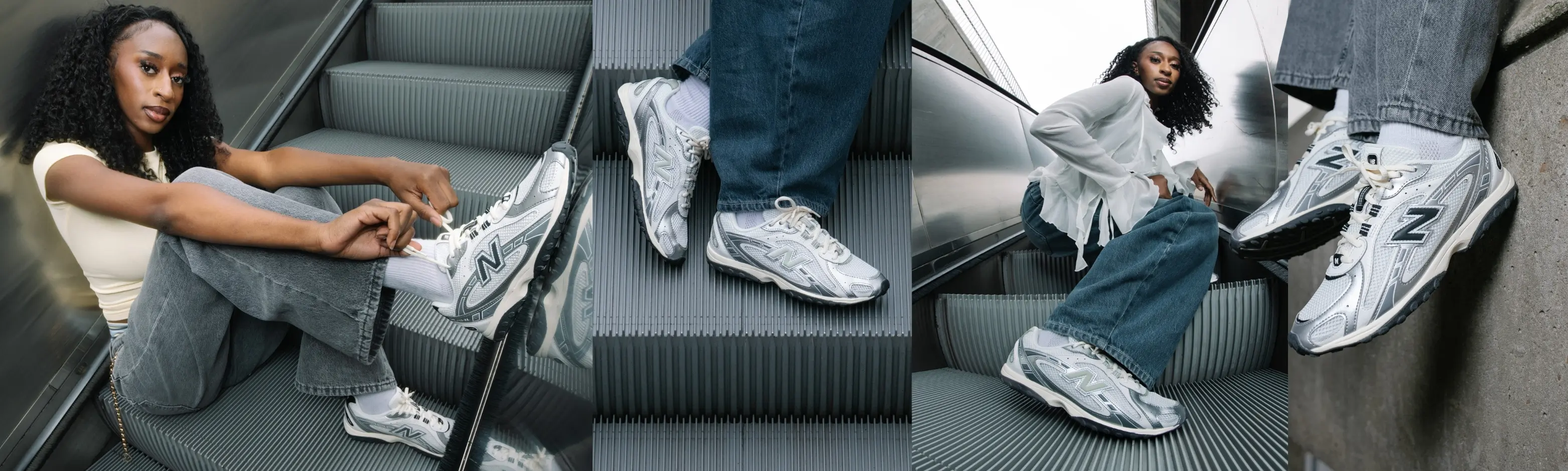
While many brands chase extravagance, New Balance reinforces a narrative in which comfort becomes an aesthetic declaration. Models like the 860v2 embody the evolution of the “dad shoe”: no longer ironic, but consciously chosen. Robust soles and technical panels read as functional honesty. Around these references grows an idea of everyday luxury: walking for hours without compromising body or style. The person who chooses New Balance does not seek external validation; they construct an intimate uniform that privileges stability, coherence, and calm in an accelerated environment.

Sneakerinas: Delicacy in Motion

Sneakerinas consolidate a new sensitivity in urban footwear. This hybrid between sneaker and ballet flat synthesizes balletcore aesthetics through a functional lens. Brands like Cecilie Bahnsen explore the silhouette with ribbons, flexible soles, and a lightness that invites a gentler inhabiting of the body. Adidas joins with models like the Taekwondo Mei, where martial inspiration fuses with delicacy. The result is a shoe that does not impose strength, but presence. In this narrative, fragility ceases to be weakness and becomes a form of quiet power.

Urban Running: The Desire to Move Forward

The rise of running shoes in urban contexts reflects a deeper collective aspiration. High-performance models, designed for endurance, communicate energy, resistance, and projection. Even outside athletic settings, these pairs function as symbols of intention. Wearing them does not necessarily mean running faster, but living with a narrative of constant movement. In a world marked by uncertainty, the moving body becomes a metaphor for progress, even when the pace is internal.

Salomon: Everyday Adventure

Salomon definitively crosses the boundary between mountain and city. Silhouettes designed for extreme terrain integrate into urban landscapes as a response to unpredictable living. High-grip soles, technical lacing, and tactical palettes align with an aesthetic that understands the city as shifting ground. Wearing Salomon is not merely functional; it is declarative. The message is clear: preparedness not driven by fear, but by curiosity and openness to the unexpected.

Choosing footwear in 2026 is no longer about accumulation, but about recognition. Classic sneakers 2026 do not promise constant novelty or immediate validation; they promise continuity. They are pieces that age alongside the body, accumulate meaning through use, and integrate into everyday biography. In a culture dominated by speed and disposability, choosing them is a way of returning to center. Walking with intention, step by step, becomes the most contemporary gesture of all.

Author: Andrés David Vargas Quesada